

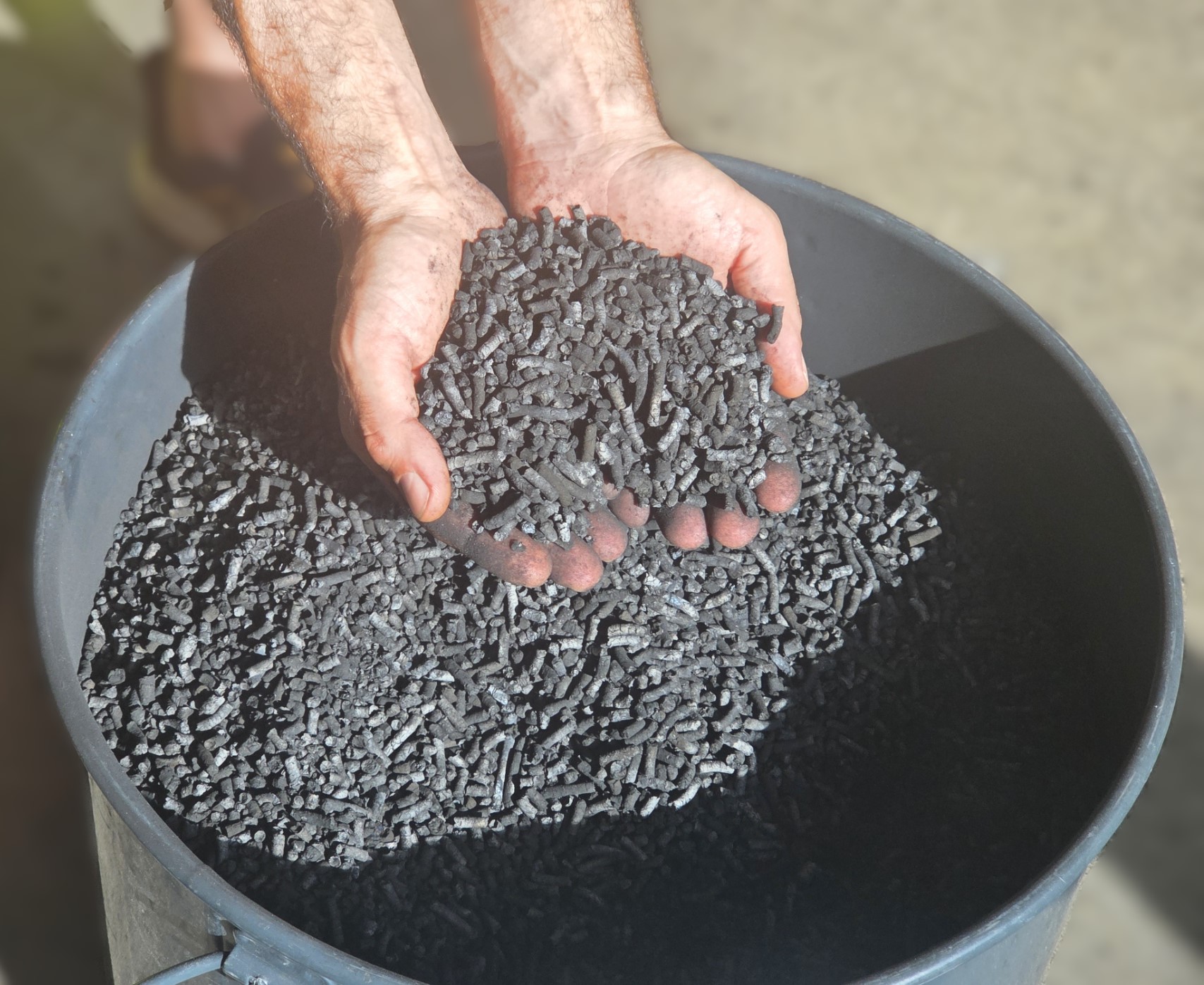
Biochar is a solid, carbon-rich material obtained by the thermal conversion of biomass in the absence, or near-absence, of oxygen. In recent years it has attracted considerable attention for its potential in soil regeneration, sustainable organic waste management and climate change mitigation.
What is biochar
Biochar is, in essence, a type of charcoal produced in a controlled manner. Unlike charcoal used as a fuel, biochar is designed primarily for agricultural and environmental applications.
It is characterised by:
- high porosity, which makes it capable of retaining water and nutrients;
- chemical stability, allowing it to remain in the soil for hundreds or thousands of years;
- a high carbon content, derived from the original biomass.
The biomasses used can include:
- agricultural residues;
- forestry waste;
- fruit shells or pits;
- organic industrial or urban residues.
How biochar is produced
Biochar is produced through a process called pyrolysis, the thermal decomposition of organic matter starting at around 350 °C in the absence of oxygen.
BioGS uses an evolution of this process in which the supply of oxygen is not completely absent but controlled such that partial combustion raises the process temperature to achieve what is known as gasification, resulting in greater production of combustible gas and biochar with a particularly high carbon content.
Benefits of biochar
Thanks to its high carbon content and highly porous structure, biochar provides a range of environmental, agronomic and technological benefits.
1. Soil quality improvement
- increases water absorption, acting as a genuine sponge;
- reduces leaching of nutrients such as nitrogen and phosphorus;
- promotes the development of beneficial micro-organisms.
This translates into better plant growth and higher agricultural yields, accompanied by a reduced need for irrigation and fertilisers.
2. Carbon sequestration
One of the most important benefits is the ability to store carbon in the soil for long periods. During growth, plants absorb CO₂ from the air, fixing it in their tissues through photosynthesis. By converting biomass into biochar:
- carbon remains trapped in a stable solid form;
- immediate release of CO₂ is avoided (as would occur with decomposition or combustion).
The entire cycle, from plant growth to transformation, therefore removes carbon from the air, making biochar a promising tool for countering climate change and reducing net greenhouse gas emissions.
3. Sustainable organic waste management
Biochar makes it possible to valorise waste and residues that would otherwise be landfilled or burned without any recovery. By turning residues into a resource, environmental impact is reduced and a useful product is created, in keeping with circular economy principles.
How biochar is used
Thanks to its versatile properties, biochar is used in numerous fields.
1. Agriculture and horticulture
This is the primary field of application: it is incorporated into the top 15–20 cm of soil or mixed into growing substrates. The dosage depends on the specific characteristics of the biochar used.
2. Forestry and reforestation
- improving tree growth;
- restoring fertility or increasing the resilience of degraded soils.
3. Water treatment
- adsorbing contaminants;
- filtering water.
4. Livestock farming
- added to feed as a natural supplement, it improves intestinal health, optimises nutrient assimilation and limits fermentation, thereby reducing enteric methane production;
- as bedding or added to slurry tanks, it improves effluent management by reducing odours and the dispersion of nitrogen and nutrients.
5. Construction and materials
- additive for concrete and mortars, to improve their mechanical properties, reduce density, promote hydration, and increase thermal insulation and anti-mould capacity;
- filler component for thermal and acoustic insulation materials, thanks to its low thermal conductivity and porous structure.
BioGS Char
The biochar produced by BioGS-1.0 systems at KiRa Technology's facility is approved for use in organic farming as a soil improver under the designation BioGS Char, in compliance with EU Regulation 2019/1009 on EU fertilising products (soil improvers category).
Technical specifications:- Total organic carbon: 96.6% d.m.
- Dry residue at 105 °C: 99.1%
- pH: 10.4
- Total Nitrogen (N): 0.26% d.m.
- Germination index: 97.2%
- Maximum water retention: 156%
Every kilogram of BioGS Char contains 0.97 kg of stable carbon and sequesters 3.5 kg of CO₂ equivalent.