

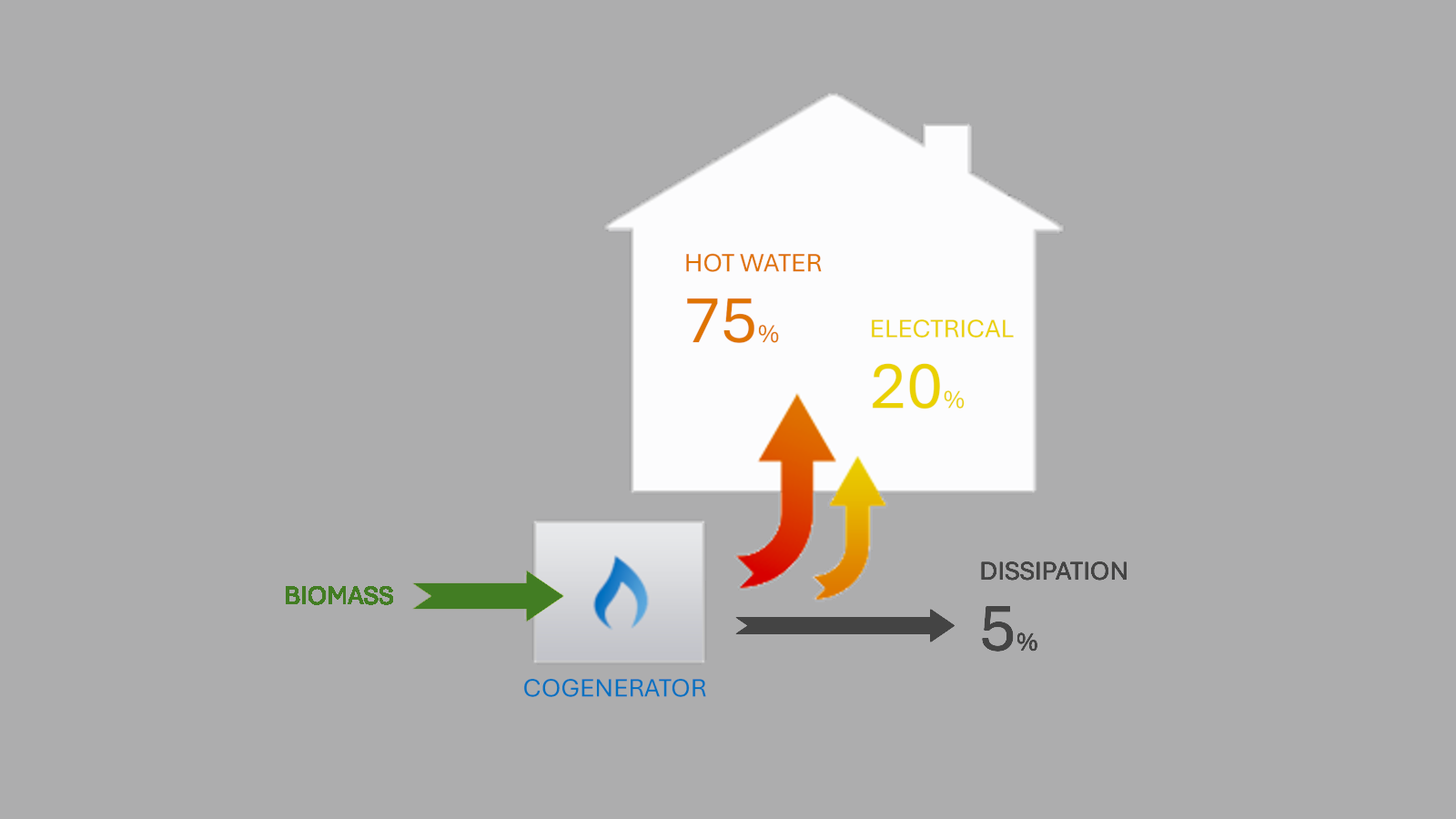
The inefficiency of separate generation
A conventional natural gas power plant converts 45–60% of fuel energy into electricity. The remaining 40–55% is dissipated as heat in flue gases and cooling systems. A boiler, conversely, converts fuel into heat with efficiencies of 85–95%, but produces no electricity: every kWh consumed by the building must be purchased from the grid, with transmission losses of 7–9% and an emissions impact linked to the national energy mix.
Cogeneration (Combined Heat and Power, CHP) resolves this inefficiency at the root: a single system simultaneously produces electrical energy and useful heat from the same fuel, on-site. The result is an overall fuel utilisation efficiency structurally superior to that of separate systems.
CAR qualification and primary energy saving
Directive 2012/27/EU defines "High Efficiency Cogeneration" (HEC) as a plant that achieves a positive PES (Primary Energy Saving) relative to the separate generation reference. The PES measures how much primary energy is saved compared to producing the same quantities of electricity and heat separately with conventional reference systems.
For micro-cogeneration units (Pe < 50 kWe), EU Directive 2012/27/EU sets an accessible threshold: a PES > 0% is sufficient to qualify as High Efficiency Cogeneration (HEC). Each member state implements its own recognition and incentive scheme - contact your national energy authority for information on available support mechanisms and certifiable energy savings tracking.
A well-designed biomass micro-cogeneration system, with full recovery of cooling heat and flue gases, can achieve overall efficiencies in the order of 90–95%, well above the minimum HEC threshold of 75% stipulated by the Directive for external combustion engines. This overall efficiency typically corresponds to a PES of 25–35%, indicating a real and measurable primary energy saving compared to separate systems.
The BioGS-1.0, under forecast operating conditions at 5,000 equivalent annual hours, achieves an overall efficiency of 94.95% and a PES of 30.03%, calculated in accordance with EU Regulation 2015/2402 using reference values for wood pellets. The expected primary energy saving compared to separate production is approximately 15.83 MWh/year (about 2.96 toe/year).
Where cogeneration excels
Cogeneration is most effective when both forms of produced energy (electrical and thermal) are actually utilised. Its key advantage is expressed in situations where demand for both exists simultaneously.
The fields in which biomass micro-cogeneration delivers maximum potential are:
- Off-grid installations: autonomous dwellings, agritourism farms, mountain refuges, alpine farmsteads, agricultural enterprises remote from the electricity grid, where the cost of conventional energy is high and continuity of supply is not guaranteed. In this context, the BioGS-1.0 operates in island mode, replacing diesel generators and traditional boilers with a single renewable source.
- High thermal demand: space heating, domestic hot water production, drying of agricultural products or biomasses, greenhouses. The greater the utilisation of the heat produced, the higher the real cogeneration efficiency and the primary energy saving.
- Availability of local biomass: forestry enterprises, sawmills, pellet producers, agricultural cooperatives with lignocellulosic residues. Short supply chains eliminate fuel transport costs and minimise the system's carbon footprint.
- Contexts where biochar has agronomic value: the by-product of gasification is a certifiable soil improver (EU Regulation 2019/1009) and a vector for permanent carbon sequestration. On agricultural holdings, biochar produced on-site closes a virtuous cycle between soil, crop and energy plant.
The combination of these factors (energy autonomy, heat always utilised, local fuel, valorised biochar) defines the ideal BioGS-1.0 user profile and the context in which biomass micro-cogeneration expresses a competitive advantage difficult to replicate with other technologies.