

1816: an engine born to survive explosions
On 27 September 1816, the Scottish clergyman Robert Stirling filed the patent for an "Economy Air Engine" with the explicit aim of offering a safe alternative to the steam boilers of the era, which exploded with dramatic frequency in mines and factories. Stirling's principle was radically different: no excessive pressure, no internal combustion, no risk of explosion. Just heat applied externally and air (or another gas) expanding and compressing in a closed cycle.
For nearly a century the Stirling engine enjoyed modest commercial success, then was overshadowed by the rapid ascent of the internal combustion engine, more compact, more powerful, faster. It became a laboratory and museum object. But its story was not over: from the 1970s onwards, with the energy crisis and growing focus on efficiency and emissions, engineers and researchers rediscovered the versatility of the Stirling cycle for applications where reliability and longevity matter more than power density.
The thermodynamic cycle: four transformations, one regenerator
The ideal Stirling cycle consists of four thermodynamic processes:
- Isothermal expansion (A→B): the gas is in the hot zone (TH). It absorbs heat and expands, performing mechanical work.
- Isochoric cooling (B→C): the gas passes through the regenerator, transferring heat to it. Constant volume, pressure falls.
- Isothermal compression (C→D): the gas is in the cold zone (TC). It releases heat externally and is compressed.
- Isochoric heating (D→A): the gas recovers from the regenerator the heat transferred in B→C. Constant volume, pressure rises.
The green area = net work W.
The regenerator is the element that distinguishes the Stirling engine from any other thermal cycle: it is a heat accumulator that recovers energy during the cooling phase and returns it during the heating phase. Without a regenerator, all this energy would be lost; with a regenerator of 95–99% efficiency (as found in modern Stirling engines), the overall thermodynamic efficiency approaches the theoretical Carnot limit: η = 1 − TC/TH.
Alpha, beta, gamma and free-piston: constructive configurations
The thermodynamic principle of the Stirling cycle can be realised in various mechanical configurations:
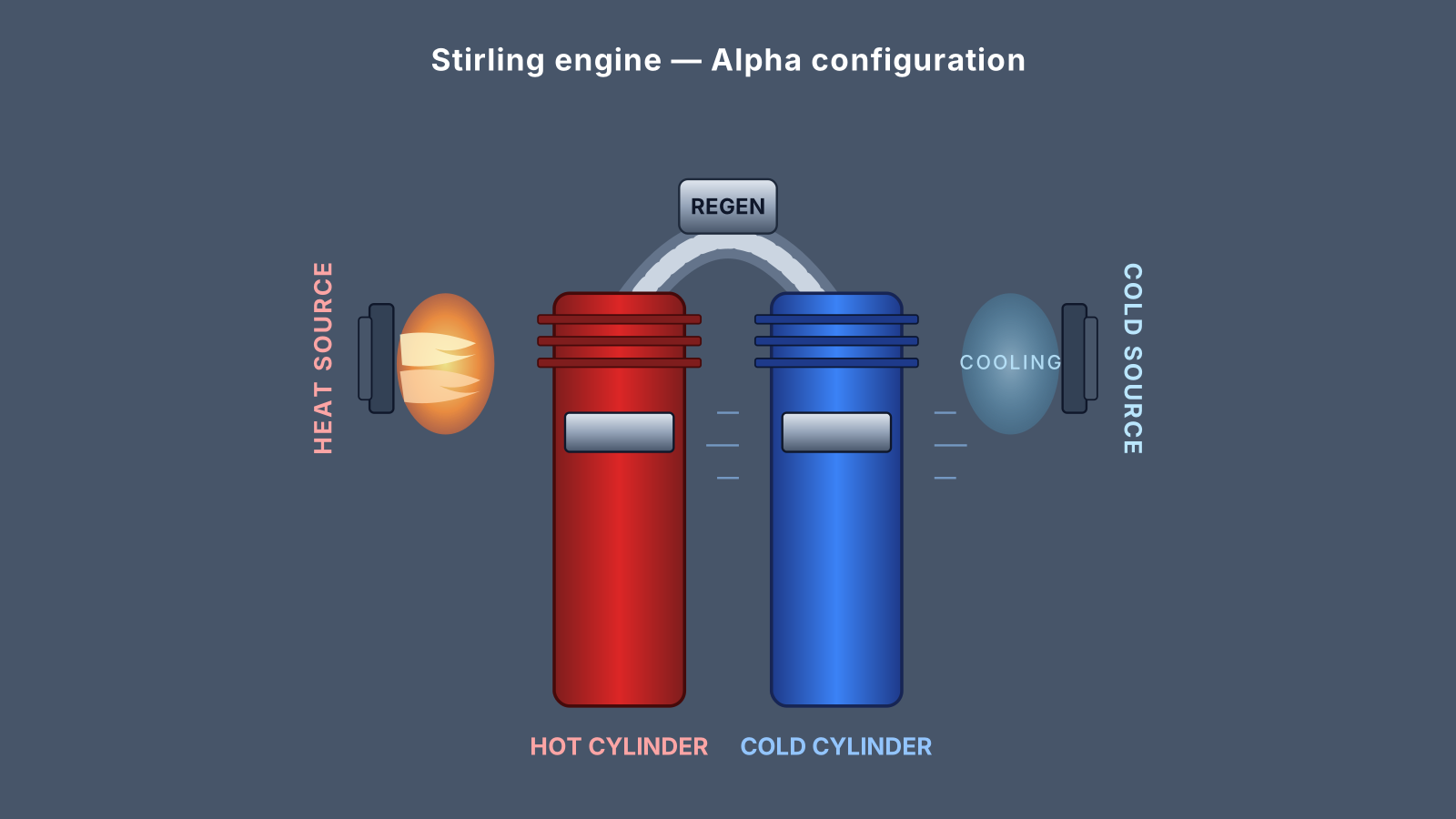
- Alpha configuration: two pistons in separate cylinders, one hot and one cold, mechanically linked at 90° phase difference. High specific power, but sealing problems in the hot zone.
- Beta configuration: power piston and displacer in the same cylinder. The displacer moves gas between the hot and cold zones; the piston converts pressure variation into work. Compact and reliable.
- Gamma configuration: similar to beta, but piston and displacer are in separate communicating cylinders. Easier to build and seal, preferred in small-scale applications.
- Free-piston: a category apart from the three above. There is no rigid mechanical linkage (crankshaft, connecting rod) between components: displacer and power piston oscillate in resonance by means of mechanical or gas springs. The output is not rotating mechanical but direct electrical, via an integrated linear alternator. This architecture almost completely eliminates friction, reduces wear points to zero and allows an operating life of tens of thousands of hours without routine maintenance.
The Stirling engine of the BioGS-1.0 is a free-piston pressurised with helium. The choice of helium as the working gas is not coincidental: its thermal conductivity and diffusivity are markedly superior to those of air or nitrogen, which reduces pumping losses and brings the engine's efficiency closer to that of the ideal cycle.
Why Stirling wins in biomass micro-cogeneration
A direct comparison between the Stirling engine and the internal combustion engine (ICE) for biomass micro-cogeneration highlights the structural advantages of the former in this specific application context:
- External combustion: the Stirling engine never comes into contact with the fuel. The syngas produced by biomass gasification always contains a residual fraction of tar and fine particulate that, in an ICE, progressively contaminates the lubricating oil, deposits on pistons and wears cylinder walls, reducing operational life and increasing maintenance frequency. In the BioGS-1.0 none of this exists: heat is transferred to the Stirling hot head through a dedicated heat exchanger, and the engine remains completely isolated from the combustion chemistry.
- Maintenance: an ICE in cogeneration requires maintenance every 4,000–8,000 hours; a sealed free-piston Stirling can operate without any internal intervention for 50,000–80,000 hours. The only scheduled interventions on the engine concern cleaning the heat exchanger inside the burner.
- Noise and vibrations: the ICE operates through repeated combustions, controlled detonations that generate pressure pulses and significant mechanical vibrations, requiring anti-vibration mounts, soundproofing and distance from inhabited areas. The Stirling engine operates through progressive gas expansion: no detonation, no impulse. The free-piston configuration also eliminates the rotary kinematic vibrations typical of alpha, beta and gamma configurations. The sound level of the BioGS-1.0 during operation is comparable to that of a medium-sized air conditioner, making installation compatible even with residential or agritourism environments.