

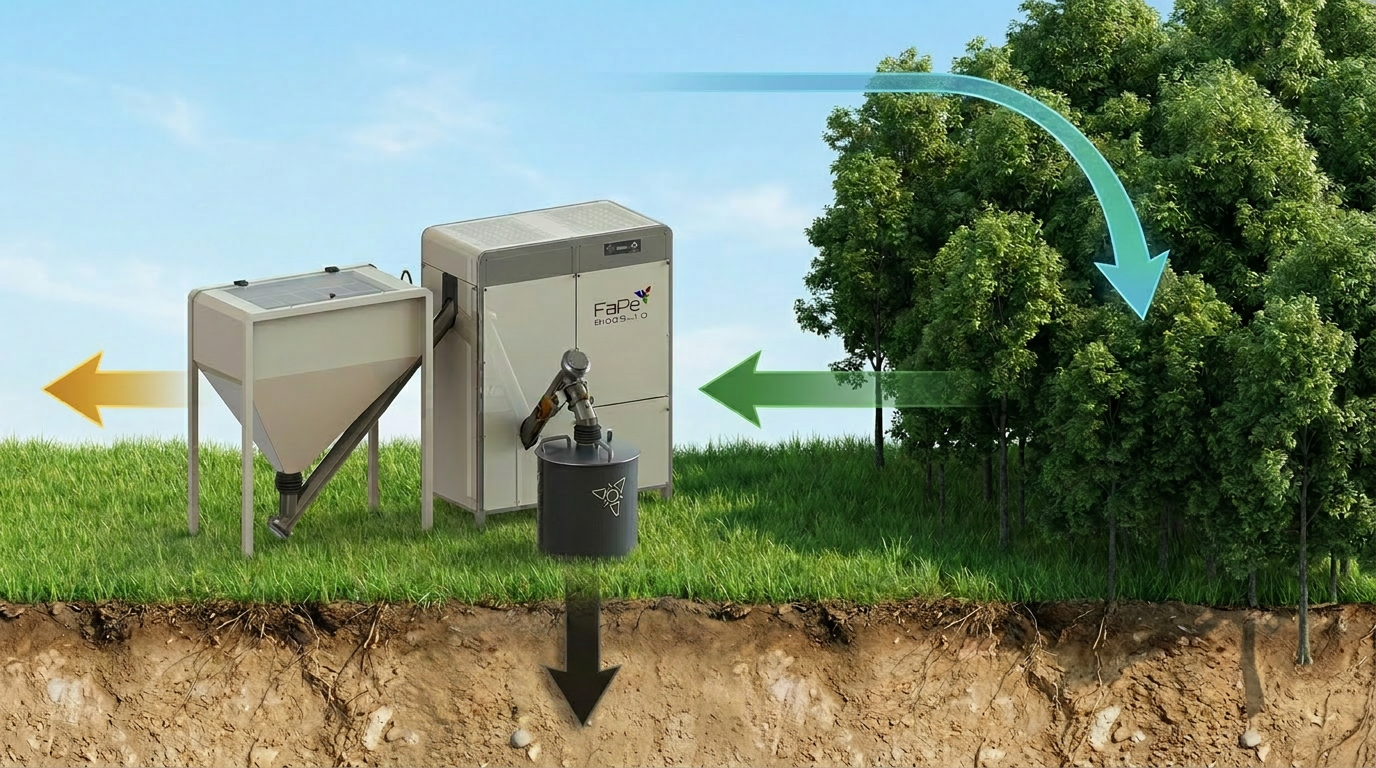
Three definitions that are not synonyms: carbon neutral, net zero, carbon negative
In public debate and corporate communications, the terms "carbon neutral", "net zero" and "carbon negative" are often used interchangeably, creating confusion about the real performance of energy systems. A rigorous definition is the starting point for understanding why the BioGS-1.0 belongs to the most advanced category.
- Carbon neutral: the CO₂ emissions produced are offset by equivalent absorption in the same accounting period. The net balance is zero, but no permanent removal from the atmosphere takes place. Example: a growing forest that offsets the emissions of an activity. The problem is that if the forest burns, all the carbon returns to the atmosphere immediately.
- Net zero: the direct and indirect emissions of the entire value chain (scope 1, 2, 3 under the GHG Protocol) are reduced to a minimum, with compensation only for residual emissions that cannot be eliminated. This is the goal of the Paris Agreement for 2050.
- Carbon negative (or climate positive): the activity removes more carbon from the atmosphere than it emits on an annual basis, permanently and verifiably. It is not just compensation - it is net removal. This is the category in which the BioGS-1.0 sits, thanks to the permanent sequestration of biochar.
The IPCC protocol for counting biogenic emissions
The starting point for understanding the carbon balance of the BioGS-1.0 is the treatment of biogenic emissions, the CO₂ emissions that result from the combustion of biomass.
According to the IPCC guidelines (2006 IPCC Guidelines for National Greenhouse Gas Inventories), biogenic CO₂ emissions must be counted as zero in the "energy" and "industry" sectors, provided that the biomass comes from sustainably managed forests or crops (meaning the biomass consumed is regrown within the same time frame). The rationale is that the carbon emitted had previously been removed from the atmosphere by photosynthesis: the cycle is closed.
This accounting treatment differs from that of fossil emissions, which add to the earth-atmosphere system carbon that had been "locked away" for millions of years. One tonne of CO₂ from natural gas combustion is different from one tonne of CO₂ from wood combustion: the former is a net addition to the system, the latter is a recirculation.
The consequence is that the gasification of sustainable pellet in the BioGS-1.0 starts from a biogenic CO₂ balance = 0. The active removal mechanisms described below produce a net negative balance.
BECCS: the climate strategy of the future, already implemented today
The BioGS-1.0 is an example of a BECCS (Bioenergy with Carbon Capture and Storage) system, identified by the IPCC as one of the CDR (Carbon Dioxide Removal) tools with the greatest potential to keep global warming below 1.5°C.
In conventional BECCS, the CO₂ produced from biomass combustion is chemically captured and injected into geological formations. In the BioGS-1.0, sequestration occurs in an even more direct way: a fraction of the carbon in the biomass is never converted into CO₂, but remains as stable biochar in the soil for centuries or millennia. It requires no costly capture and storage infrastructure: the "capture" occurs in the reactor itself, and the "sequestration" occurs in the agricultural soil where the biochar is applied.
The three carbon removal mechanisms of the BioGS-1.0
1. Biogenic absorption from biomass
Every kilogram of lignocellulosic biomass contains approximately 0.45-0.50 kg of carbon, absorbed by the plant during its life through photosynthesis. This carbon was in the atmosphere as CO₂; the plant incorporated it into cellulose, hemicellulose and lignin. When the biomass is gasified in the BioGS-1.0, most of this carbon is converted into syngas (CO, CH₄) and then emitted as CO₂ from combustion in the burner. But, as explained in the IPCC section, these biogenic emissions have a zero balance.
2. Permanent sequestration in biochar
In downdraft open-core gasification, approximately 10-12% of the incoming carbon is not converted into syngas, but remains as solid char with a carbon content ≥ 96% on a dry basis. This carbon is in condensed aromatic form (H/C ratio < 0.4) and is not released into the atmosphere through normal biological or chemical processes: it is carbon permanently removed from the atmosphere.
Assuming 5,000 operating hours per year, the BioGS-1.0 consumes approximately 9.5 t of pellet, producing 220–240 g/h of biochar, equivalent to 1.1–1.2 t/year. With a carbon content of 96%, the fixed carbon sequestered is approximately 1.06–1.15 t C/year, equivalent to ≈ 3.8–4.2 t CO₂/year of permanent net removal from the atmosphere.
3. Substitution of fossil fuels
Every kWh produced by the BioGS-1.0 replaces a kWh that would have been produced elsewhere, often from fossil sources. The average emission factor of the EU27 electricity grid in 2024 is approximately 0.23 kgCO₂eq/kWh (source: EEA - Greenhouse gas emission intensity of electricity generation in Europe, 2024). On an annual basis (5,000 hours × 1 kWe = 5,000 kWhe), electricity production avoids approximately 1.15 tCO₂eq/year.
The co-generated heat (6 kWt nominal, 30,000 kWht/year at 5,000 hours) replaces heat produced by natural gas or diesel boilers. Replacing 30,000 kWht/year of natural gas (0.20 kgCO₂eq/kWht) means avoiding a further 6 tCO₂eq/year.
LCA calculation: the annual carbon balance of the BioGS-1.0
Integrating the three mechanisms, the annual carbon balance of a BioGS-1.0 operating 5,000 equivalent hours/year in a typical European context is:
- Direct emissions (pellet life cycle, auxiliaries, maintenance): +0.5 tCO₂eq
- Removal from biochar sequestration: -3.8 tCO₂eq
- Avoided emissions (substitution of grid electricity): -1.1 tCO₂eq
- Avoided emissions (substitution of heat from gas): -6.0 tCO₂eq
- Annual net balance: approximately -10 tCO₂eq per unit
The result is that every year of operation the BioGS-1.0 removes approximately 10 equivalent tonnes of CO₂ from the atmosphere - a structural carbon-negative balance, not dependent on offsets or external compensation. Installing multiple units in an energy community or agricultural district, the impact multiplies linearly.