

Introduction
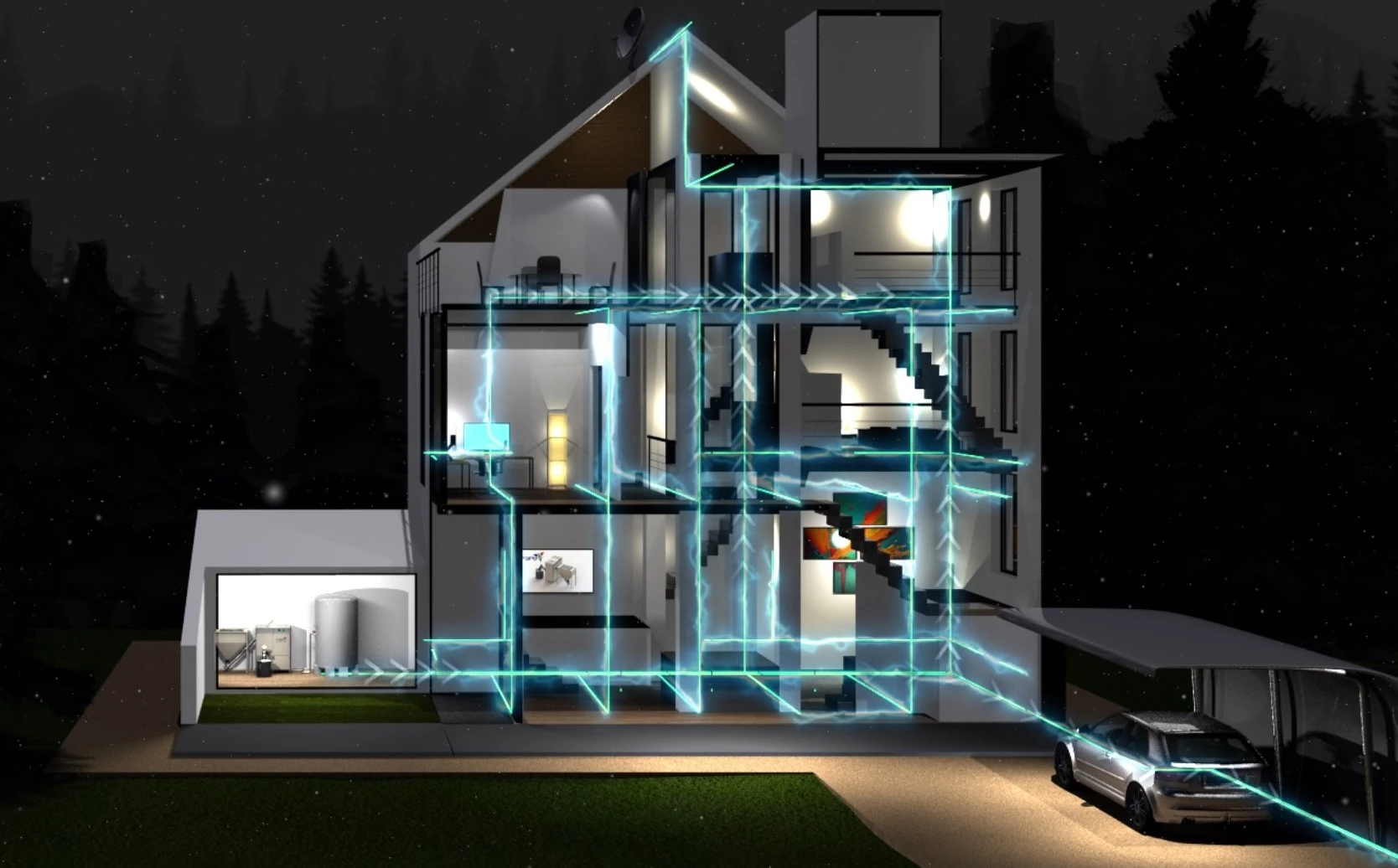
An energy-independent home is a dwelling able to cover its own energy needs through local sources, storage systems and smart consumption management. The goal is not just to reduce bills, but to increase efficiency and resilience, gaining independence from the energy grid.
Energy autonomy does not depend on a single technology, but on the ability to effectively integrate production, storage and use of energy. Understanding how these elements work together is the first step toward designing a truly self-sufficient home.
There is no single best solution, only the right solution for the specific case
Energy autonomy for a home is not achieved by installing "the" best technology, because there is no single best technology in absolute terms: there is the combination best suited to that home's specific needs. Photovoltaics, small-scale wind, heat pumps, gas or biomass cogeneration are not competing alternatives, but components that, when properly integrated, offset one another during the periods and conditions in which one of the sources is less effective.
Photovoltaics produce when there is solar radiation, but their availability does not always coincide with peak household consumption. In addition, during winter months production is generally lower than in summer, precisely when heating demand tends to increase. Small-scale wind depends heavily on local wind conditions, exposure and the absence of obstacles. Cogeneration, whether gas or biomass, produces on demand, in a programmable way, but requires fuel and the use of both forms of energy it produces (electrical and thermal).
None of these sources alone can continuously guarantee coverage of energy needs throughout the year with adequate safety margins. Correctly designing an autonomous home therefore starts from a different question: not "which technology to choose," but "which combination of technologies to adopt and how to make them work together."
The role of storage: batteries and thermal puffer tanks
A generation system alone is not enough to make a home autonomous: what is needed is the ability to decouple the moment energy is produced from the moment it is consumed. This is the role of storage, both electrical and thermal.
- Electrical storage (battery) - absorbs the electrical energy produced in excess of instantaneous consumption and returns it when production is insufficient or absent. With a micro-cogenerator like BioGS-1.0, the battery also plays a second role: it makes it possible to meet power peaks higher than the generator's rated output, because the instantaneous power required by an appliance does not necessarily have to be supplied entirely by the generator, but can be partly drawn from the already-charged storage.
- Thermal storage (puffer tank) - a technical water tank that stores the heat produced while the generator is running, to release it when heating or domestic hot water is needed, regardless of whether the generator is on or off at that moment. The puffer tank allows a cogeneration system to operate with ignition cycles optimized for efficiency, instead of continuously chasing instantaneous heat demand.
In many cases, the energy autonomy perceived by the user depends more on the quality of the storage system than on the rated power of the installed generator. Without adequate storage capacity, every generation source must be sized for peak consumption, wasting installed capacity for most hours of the year. With properly sized storage, generation can be designed around average demand, while peaks are covered by stored energy.
Optimizing consumption: shifting loads to surplus periods
The second lever, often overlooked, does not concern production but consumption. Many household loads do not have a mandatory schedule: washing machine, dishwasher, electric vehicle charging, pool pump or thermal storage systems can often be scheduled.
Running them during periods when the system has an energy surplus, instead of at times chosen purely for convenience, reduces both grid draw and the oversizing required for storage.
With photovoltaics this principle is now well known: using appliances during the middle of the day makes it possible to directly exploit panel production. With a micro-cogeneration system the principle remains the same, but the surplus does not depend on the sun: it depends on the generator's operating cycle.
A system like BioGS-1.0, which can operate continuously for up to 24 hours a day, makes it possible to schedule flexible loads during periods when the system is already running to cover thermal demand, obtaining additional electrical energy during a cycle already activated to meet heat demand. Good scheduling of flexible loads also reduces the number of start-stop cycles, increasing overall efficiency.
A common mistake: using electrical energy to produce hot water when heat is already available
A design mistake that can occur in integrated systems consists of using electrical energy to produce domestic hot water when a source of recovered heat from a cogeneration system is already available. When a cogeneration plant is already operating, it is almost always less efficient to use electrical energy to produce domestic hot water when recovered heat is immediately available and not yet put to use.
Electrical energy is generally the most versatile form within the home energy system: it powers appliances, lighting, electronics and, increasingly, electric mobility. When heat is already available as a byproduct of the cogeneration process, it can be advantageous to direct it primarily toward domestic hot water production and heating.
The assessment should still be made on a case-by-case basis, taking into account energy costs, availability of recovered heat, plant characteristics and how the building is used.
A properly sized puffer tank makes this management easier: domestic hot water can be supplied by the stored heat, while any electrical backup systems only intervene in exceptional situations where thermal storage is not sufficient.
Comparing the technologies
| Technology | Electrical energy | Heat | Works in winter | Off-grid | When it makes sense |
|---|---|---|---|---|---|
| Photovoltaics + storage | Yes | No | Limited | Yes, with seasonal limits | Good exposure, low thermal demand |
| Small-scale wind | Yes | No | Depends on site | Yes, with site limits | Windy areas, integration with photovoltaics |
| Heat pump | No (consumes) | Yes | Yes, lower COP | Requires an electrical source | Good insulation, electrical production available |
| Gas micro-cogeneration | Yes | Yes | Yes | Limited | Significant thermal demand, natural gas or LPG availability |
| Biomass micro-cogeneration | Yes | Yes | Yes | Yes | Significant thermal demand, biomass availability |
No row in the table represents a universal solution. Each technology has specific strengths and limitations. Real energy autonomy comes from integrating multiple systems, supported by adequate storage and smart consumption management.
The role of biomass in an integrated system
Among biomass-based solutions are micro-cogeneration systems such as BioGS-1.0, which help address some of the typical limitations of non-programmable renewable sources.
BioGS-1.0 converts pellets and other plant biomass into syngas through pyrolytic gasification and uses it in a Stirling engine, producing up to 24 kWh of electrical energy and 140 kWh of thermal energy per day, plus biochar as a solid byproduct.
In a system integrated with photovoltaics, electrical storage and a properly sized thermal puffer tank, a solution of this kind improves energy coverage during the most critical periods of the year, such as winter months, evening hours and days with reduced solar production.
Ultimately, the contribution of biomass should not be seen as an alternative to other technologies, but as a possible component of an integrated energy system. The goal of energy autonomy is not, in fact, to rely on a single source, but to combine generation, storage and smart consumption management to ensure continuity and efficiency throughout the year.
A typical case: a detached house in Romagna
Simulation with the calculator: a 110 m² detached house in Savignano sul Rubicone, energy class C, 3 occupants, an existing 2 kWp south-facing photovoltaic system.
About 150 kWh/year remain to be drawn from the grid. The estimate is preliminary and of low reliability, because actual consumption data were not entered.
To explore further practical aspects, also see the frequently asked questions about BioGS-1.0.
Related questions
For a preliminary estimate for your case: Calculate your energy autonomy. Data, formulas and sources of the calculation: methodology.