

Soil amendment, fertilizer, corrective: legal definitions
Before looking at the role biochar plays in soil management, it is worth clarifying the regulatory definitions, which are often confused even among industry operators.
Regulation (EU) 2019/1009 on fertilizing products, in force since July 2022, establishes:
- Fertilizer: a product that supplies essential nutrients to plants (nitrogen, phosphorus, potassium and micronutrients). Its main effect is nutritional.
- Soil improver (ammendante): a product intended to be added to soil to maintain, improve or protect its physical, chemical or biological properties, without a significant primary nutrient input. Its effect is on soil structure and biology.
- Liming/corrective material: a product aimed at correcting unfavourable soil chemical properties, in particular pH. High-pH biochar also acts as a corrective material.
Biochar can be marketed as a soil improver (PFC 3, Soil Improver) under Regulation (EU) 2019/1009; at the component material level it falls under CMC 14 (Pyrolysis and Gasification Materials). In Italy it is registered in the SIAN database as a soil improver for use in both conventional and organic farming, in compliance with Regulation (EU) 2018/848 on organic production. BioGS Char meets the purity requirements for use in organic farming.
Biochar should not be understood as a substitute for fertilizers, but as a tool that improves their efficiency over the long term: it acts on soil structure and biology, not on the direct supply of nutrients.
Terra preta do índio: the historical discovery that changed soil science
Using biochar as a soil amendment is not a modern invention: it is the rediscovery of a millennia-old practice documented in pre-Columbian Amazonia.
Terra preta do índio (literally "black earth of the natives" in Portuguese) is an anthropogenic soil of intense black colour, found in patches of a few dozen hectares across various areas of the Amazon basin. Pedological and radiocarbon studies have dated these soils to between 450 BC and 950 AD: pre-Columbian Amazonian populations deliberately created fertile soils by incorporating charcoal, organic residues, bones and ceramics.
The extraordinary feature of terra preta is its stability over time: 2,000 years later, these soils still maintain exceptional fertility compared with the surrounding Amazonian soils (oxisols and ultisols, notoriously poor). The carbon from the original biochar is still present and microbiologically active. This observation has driven, since the early 2000s, intense international scientific research that led to the rediscovery of biochar as a tool for sustainable soil management.
The presence of biochar is not the only factor responsible for the fertility of terra preta, but it is considered one of the key elements behind its extraordinary persistence over time.
How biochar works in the soil
Water retention: biochar as an inorganic "sponge"
The microporosity of biochar (specific surface area of 200-400 m²/g for BioGS Char) creates a network of micropores that hold water by capillary action. In sandy soils, adding biochar at 2-5% by volume increases available water capacity by 15-30%, reducing irrigation frequency under water-stress conditions. Peer-reviewed studies (Kammann et al., 2011; Liu et al., 2017) document reductions in water consumption of 20-35% in vegetable crops treated with biochar.
Cation exchange capacity (CEC) and nutrient retention
CEC measures a soil's ability to hold positively charged cations (NH₄⁺, K⁺, Ca²⁺, Mg²⁺), making them available to roots and protecting them from leaching. Biochar increases soil CEC over the long term, through surface oxidation that creates negatively charged carboxylic and phenolic groups. The practical result is reduced nitrogen losses through leaching and greater efficiency of nitrogen fertilizers.
Microbiome: biochar as a microbial habitat
The microporosity of biochar creates refuges for soil microorganisms, protecting them from predation by protozoa and from desiccation. Research using metagenomic sequencing (Lehmann et al., 2011; Quilliam et al., 2013) shows significant increases in microbial biomass and microbiological diversity, with values that can in some cases exceed 100% relative to controls: the size of the effect depends on the type of biochar, dose, climate and soil characteristics. Particularly notable is the effect on arbuscular mycorrhizal fungi (AMF): biochar promotes mycorrhizal root colonization, improving the uptake of phosphorus and micronutrients.
Correcting pH in acidic soils
BioGS Char has a pH of 8.5-10 (alkaline), due to the carbonates and mineral oxides derived from the biomass during gasification. Applied to acidic soils (pH < 6.0), it produces a liming effect comparable to small doses of agricultural lime, bringing the pH towards the optimal range (6.0-7.5) that favours the availability of most nutrients.
Drought resistance: biochar as a climate-adaptation tool
The water retention described above becomes particularly important during periods of water scarcity, when water availability becomes the factor limiting crop yield. Three independent studies, carried out in very different contexts, converge on the same conclusion: the effect of biochar on tolerance to water stress is not marginal, and it grows precisely as drought worsens.
A 2024 meta-analysis (Zhang, Niu, Luo, Agronomy, 14(12), 2952, DOI: 10.3390/agronomy14122952), which analysed 25 studies and 283 experimental comparisons, reports under severe water stress an average yield increase of 33% and a 62% increase in photosynthetic rate, without indicating a fixed optimal dose: the effect of biochar simply strengthens as drought worsens (the measured effect size was 182% and 309% greater than under moderate and no water stress, respectively).
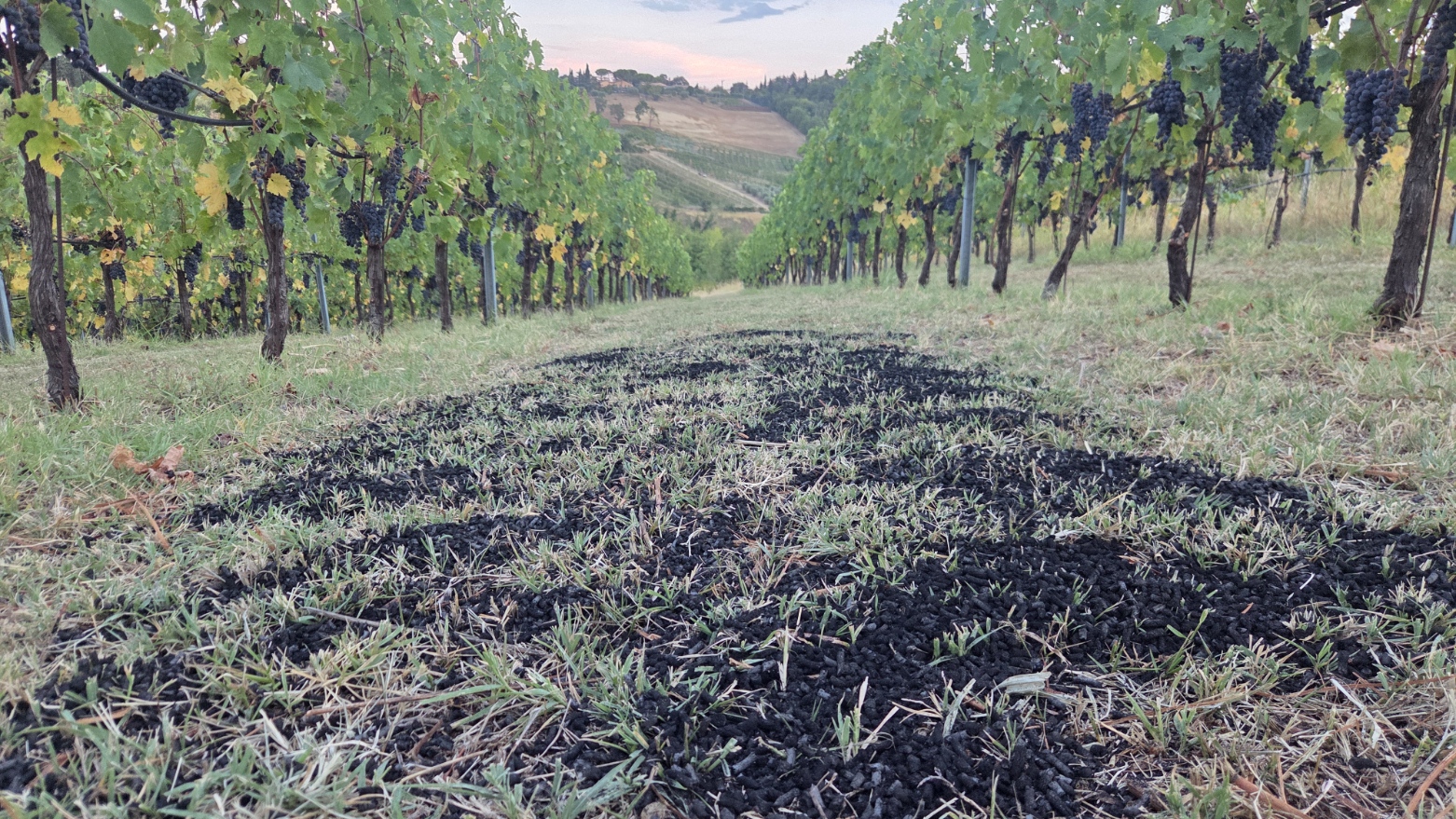
A field trial by CNR-IBIMET in a Tuscan vineyard (Baronti et al., 2014, European Journal of Agronomy, 53, 38-44, DOI: 10.1016/j.eja.2013.11.003) applied 44 tonnes per hectare of biochar to already-planted vines over two seasons (about 22 tonnes per hectare on a dry-matter basis), measuring a 7.3% increase in soil water content and an improvement in leaf water potential of up to 37% during periods of actual drought.
A two-year maize trial conducted in Pakistan (Naeem et al., 2024, Scientific Reports, 14, 25000, DOI: 10.1038/s41598-024-76082-w) compared three doses of activated biochar with five irrigation levels, identifying 5 tonnes per hectare as the optimal dose: grain yield 26% higher and water productivity 33% higher than the untreated control.
These three studies concern biochar in general, produced with technologies and biomasses different from those of BioGS-1.0: they are cited as independent scientific literature, not as results obtained with the same protocol. In parallel, analyses by an accredited third-party laboratory on BioGS Char measure a maximum water retention capacity of 156% (on a dry-weight basis) and a germination index of 97.2%: data consistent with the cited literature, which they complement without replacing it.
Optimal dosage by crop
Scientific literature and agronomic experience converge on indicative dosages that differ by crop, referring to a single or multi-year application worked into the top layer (0-20 cm):
- Leafy and fruiting vegetables (tomato, pepper, courgette, lettuce): 2-5 t/ha, preferably as biochar charged with compost.
- Cereals (wheat, maize, barley): 5-10 t/ha on sandy or acidic soils; 2-4 t/ha on clay-loam soils.
- Vineyard: 3-6 t/ha at planting or reapplied after harvest. Documented effects: improved berry quality, reduced summer water requirement.
- Olive grove: 2-4 t/ha every 3-5 years. Documented effects: reduced alternate bearing, improved drought resistance.
- Orchard (apple, pear, peach): 3-5 t/ha at planting. Documented effects: increased rooting, reduced post-transplant mortality.
Dosages above 10 t/ha do not bring proportional benefits and, in already alkaline soils, can cause temporary nitrogen immobilization. A soil analysis before application is always advisable.
The dosages given are indicative and should be adapted to local soil characteristics, organic matter content, pH and crop objectives.
"Charged" (activated) biochar: how to prepare it
Charged biochar is biochar that, before being applied to soil, has been enriched with nutrients or inoculated with beneficial microorganisms. This practice addresses one of the limitations of fresh biochar: the temporary microbial immobilization of nitrogen (the "hunger" effect) that can occur in the first 6-12 months after application.
The most widespread and scientifically verified methods:
- Co-composting biochar + compost (50:50 by volume): the biochar absorbs the nutrients released during composting; the result is an enriched, biologically active substrate. Time: 4-8 weeks.
- Charging with liquid digestate from biogas: soaking the biochar in diluted digestate (1:3) for 48-72 hours. Particularly effective for enriching ammoniacal nitrogen.
- Inoculation with AMF and PGPR bacteria: biochar acts as a carrier for microbial inoculants. Its microporosity protects the microorganisms during storage and promotes their survival after application to soil.
For customers who produce biochar with the BioGS-1.0 and intend to make agronomic use of it, KiRa Technology recommends co-composting with cattle or horse manure as the optimal charging method for the Italian rural context.
Recent scientific research: peer-reviewed evidence
The scientific literature on biochar as a soil amendment now numbers more than 3,000 peer-reviewed publications. Some of the most relevant evidence for the European context:
- Jeffery et al. (2011), Agriculture, Ecosystems & Environment: a meta-analysis of 16 studies: average increase in crop productivity of 10% with biochar.
- Jötterer et al. (2019), CATENA: a 10-year Swedish study: biochar increases wheat yield by an average of 4-8%, with peaks of 15% in drought years.
- Schmidt et al. (2021), European Journal of Agronomy: compost-charged biochar shows positive effects already in the first year; uncharged biochar takes 2-3 years to deliver its benefits.
- Palansooriya et al. (2019), Critical Reviews in Environmental Science and Technology: an average increase in microbial diversity (Shannon index) of 15-40%, with larger effects on degraded soils.
Carbon farming: the role of biochar in field carbon sequestration
"Carbon farming" refers to the set of agricultural practices that increase the carbon stored in soil, generating a measurable environmental benefit alongside a productive one. At European level the topic is covered by a dedicated regulatory framework, the EU Regulation on carbon removal certification (Carbon Removals and Certification Framework, CRCF, 2024), which aims to distinguish genuinely verifiable sequestration practices from interventions with uncertain or temporary effects.
Within this framework, biochar occupies a particular position relative to other carbon-farming practices (cover crops, reduced tillage, crop residue management): while organic carbon supplied by compost or green manure tends to mineralize and return to the atmosphere as CO2 over years or decades, biochar's carbon is in a highly stable aromatic form (hydrogen/carbon ratio below 0.4), which slows its decomposition over a timescale of centuries. The articles "Carbon negative: capturing more CO₂ than is emitted" and "Carbon sequestration in soil: biochar stability and the H/C ratio" go into more depth on, respectively, the system's LCA balance and the chemistry behind carbon stability.
For a farm, carbon farming with BioGS Char translates into a cycle that stays on the territory: the farm's residual biomass becomes electricity and heat, and the resulting biochar (over 96% organic carbon, according to the technical data sheet) goes back onto the fields the biomass came from, with no need to buy in amendments from outside or to send material off the farm. In carbon terms, every kg of BioGS Char applied to soil corresponds to more than 3 kg of CO2 stably removed from the atmosphere: a technical estimate based on organic carbon content and the molar ratio between CO2 and carbon (44/12), not a certified carbon credit. KiRa Technology does not currently sell verified carbon credits on BioGS Char: the figures given remain technical estimates to support agronomic decisions, useful for quantifying impact but not usable as formal offsetting.
The application protocol recommended by KiRa Technology
Based on the scientific literature and the operational experience gained at the pilot sites in Romagna, KiRa Technology has defined an application protocol for BioGS Char:
- Preliminary soil analysis: pH, CEC, organic carbon, particle-size distribution, total nitrogen. Essential for calibrating the dosage and determining whether charged biochar is needed.
- Preparing the BioGS Char: 4-6 weeks of co-composting with mature manure (1:2 ratio by weight) for low-fertility soils; pure application for already fertile soils.
- Application method: surface spreading followed by mechanical incorporation (light tilling or shallow ploughing, 15-20 cm). Avoid application in windy conditions given the dusty nature of fine biochar.
- Recommended standard dosage: 3-5 t/ha per single application; repeatable every 5 years. Any reduction in nitrogen fertilization should be assessed case by case, based on soil analysis and crop requirements.
- Monitoring: soil analysis 12 months after application to check changes in pH, CEC and organic carbon. KiRa Technology provides the analytical report for the BioGS Char of every batch.