

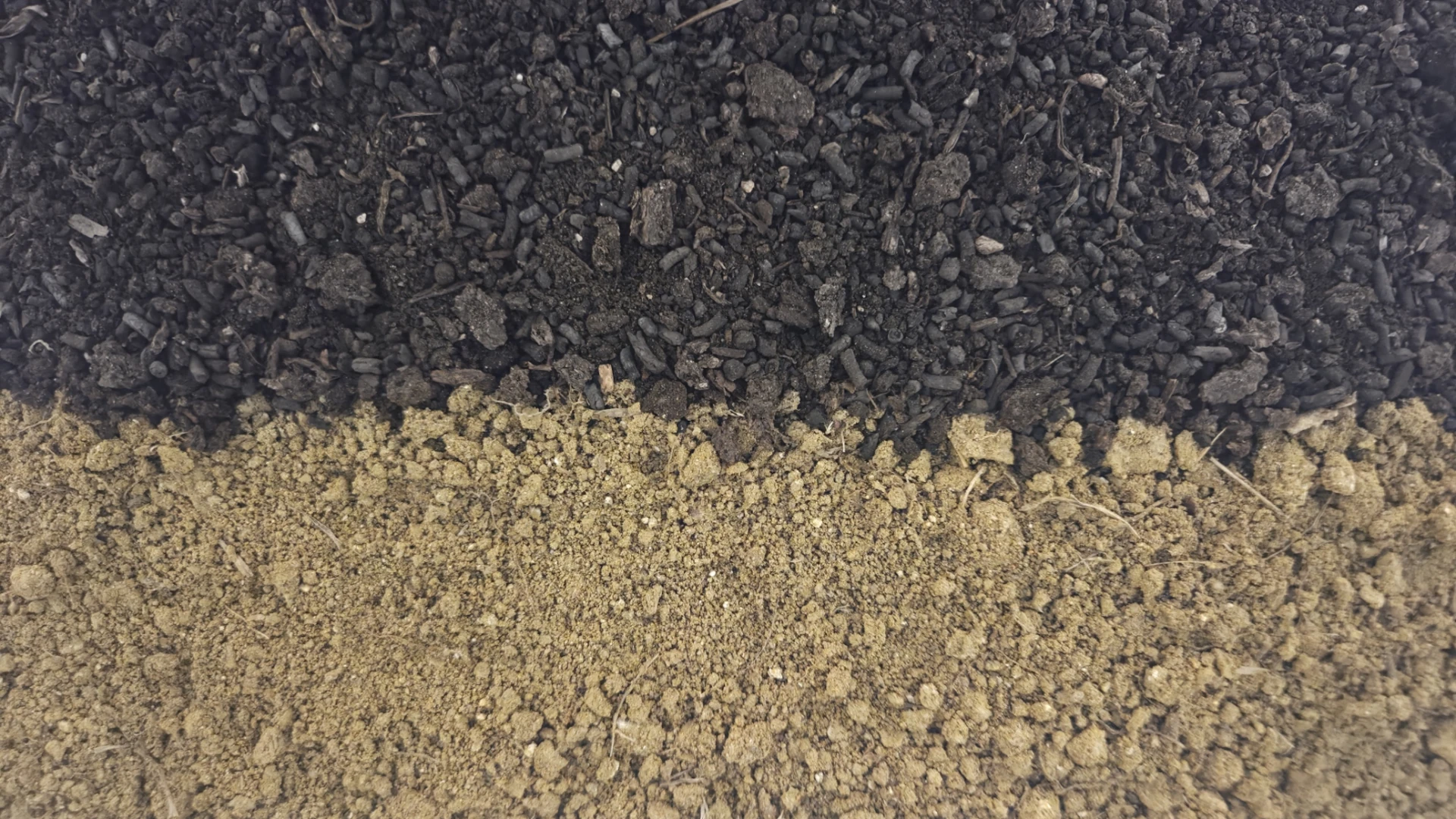
What "permanence" means in carbon sequestration
When we talk about carbon sequestration in soil, the concept of permanence is central but often misunderstood. It is not enough for an organic substance to hold carbon temporarily: that carbon must remain stable for decades, centuries or millennia, withdrawn from the atmospheric cycle in a measurable and verifiable way. In other words, it needs an intrinsic resistance to biological and chemical degradation ("recalcitrance").
Researchers distinguish two main time horizons:
- 100-year permanence - commonly used as the minimum reference in evaluations of carbon dioxide removal effectiveness and in carbon accounting systems. It corresponds to solutions such as afforestation, regenerative agriculture with crop residues incorporated into the soil, and mature compost.
- Millennial and longer permanence - achieved by materials with a highly cross-linked, condensed aromatic structure, primarily biochar. Biochar is among the leading biological sequestration solutions with millennial permanence: its aromatic fraction is not accessible to soil microorganisms, and a very high share of biochar carbon can remain stable for centuries to millennia, depending on the feedstock, pyrolysis conditions and soil.
This difference is not academic: voluntary carbon markets and upcoming European regulations increasingly value effective permanence, penalizing solutions with a high risk of "reversal" (release of previously stored carbon).
Comparison with other organic materials
To understand biochar's position as a sequestration agent, it is useful to compare it with the main organic alternatives:
- Mature compost - contains labile and semi-labile organic carbon. The annual mineralization rate is on the order of 2-5% (a typical value, but highly variable depending on compost quality, temperature, moisture and soil type): within a few decades, most of the carbon added returns to the atmosphere as CO₂. Indicative effective permanence: 20-50 years.
- Peat - ancient carbon, stabilized under anaerobic conditions. It has high permanence as long as it remains in the peatland, but drainage and drying release massive amounts of CO₂ and CH₄. The European Commission classifies it as a slow-release fossil fuel, not as CDR.
- Humus (humified organic matter) - intermediate stability, typically 100-300 years under favorable conditions, but highly sensitive to physical disturbance (deep tillage, drought). It is not an added material: it is the result of slow pedogenetic processes.
- Biochar - polycondensed carbonaceous matrix rich in aromatic rings, resistant to biological and chemical oxidation. Permanence documented in the literature: 500-5,000 years depending on pyrolysis conditions and the receiving soil. It is one of the most durable forms of biological carbon storage available today, while still remaining distinct from geological storage.
The atomic H/C ratio: why it is the scientific standard
Biochar stability cannot be assessed by eye, nor with simple total-carbon elemental analyses. The method now universally accepted by the scientific community, and adopted by the EBC (European Biochar Certificate) and IBI (International Biochar Initiative) standards, is measurement of the atomic H/C ratio.
The principle is simple but powerful: the more a carbonaceous material is aromatized (that is, dominated by condensed benzene rings), the lower the presence of hydrogen atoms relative to carbon. Aliphatic structures, which are easily biodegradable, have high H/C ratios (1.2-2.0). Condensed aromatic structures have low H/C ratios.
- H/C > 0.7 - low-stability material, high biodegradability;
- H/C 0.4-0.7 - intermediate stability, medium-quality biochar;
- H/C < 0.4 - highly condensed aromatic structures, documented permanence beyond 1,000 years (such values are generally associated with high-stability biochar and compatible with the requirements of the highest quality classes, EBC Premium class, IBI Class 1, provided the other parameters required by the standard are also met).
The operating conditions of the BioGS-1.0 (high-temperature gasification and long residence time) are designed to produce a biochar with H/C values typically associated with the highest stability classes; the actual value must be verified through elemental CHN analysis of the product.
Independent analyses of BioGS Char have shown:
- Organic carbon: 96.6% d.m.;
- Ash: 3.5% d.m.;
- Moisture: 0.9%;
- Sum of PAHs (16 EPA): 5.1 mg/kg d.m.;
- Heavy metals well below reference limits;
- Germination index: 97.2%.
The BioGS Char analyses also showed concentrations of lead, cadmium, nickel, copper, zinc and mercury well below reference limits, as well as PCBs and dioxins below the analytical quantification limits.
These values place BioGS Char among the biochars with the highest degree of carbonization normally observed in agricultural and environmental applications.
The results confirm a strongly carbonized product, with a very low contaminant content and characteristics compatible with high-quality biochar.
The European regulatory framework: EBC, IBI and IPCC CDR
Biochar as a carbon sequestration tool is now governed by a coherent set of international standards and European policies.
The European Biochar Certificate (EBC) defines quality requirements based on carbon stability, contaminant content and production process characteristics, including the H/C ratio, organic carbon content and contaminant limits. Available analyses show performance compatible with the quality requirements of the highest classes of international biochar standards; final qualification requires verification of all parameters required by the EBC and IBI standards.
The International Biochar Initiative (IBI) defines technical requirements relating to biochar quality, safe use and contaminant concentration; the main parameters considered include:
- Total Organic Carbon > 50% d.m.;
- H/C ratio < 0.7;
- extremely low heavy metal concentrations;
- Polycyclic Aromatic Hydrocarbons (PAHs) < 6.0 mg/kg.
The European Biochar Certificate (EBC), in addition to quality requirements, also defines standards for specific end uses:
- Futter: high-purity biochar for animal feed;
- AgroBio: biochar usable in organic farming;
- Agro: biochar suitable for conventional agriculture;
- Urban: biochar for use on urban soils, gardens and landscape architecture;
- Gebrauchsmaterial: biochar for use as an additive in technical materials;
- Rohstoff: biochar intended for further processing.
In its Sixth Assessment Report (AR6, 2022), the IPCC identifies biochar among the CDR (carbon dioxide removal) technologies with good scaling potential and low reversal risk. Estimates of global sequestration potential vary significantly across sources (0.3-6.6 GtCO₂/year by 2050 according to the broadest projections; more conservative central values on the order of 0.5-2 GtCO₂/year), depending on assumptions about biomass availability and technology uptake.
Regulation (EU) 2024/3012 (Carbon Removal Certification Framework, CRCF), in force since January 2025, establishes a certification framework for carbon removal activities in the Union, with biochar explicitly included among the eligible activities. Detailed implementing methodologies (delegated acts) are currently being developed by the European Commission.
Economic value: carbon credits from biochar
Every tonne of CO₂eq stably sequestered in soil through biochar can be monetized on voluntary carbon markets. The main standards issuing credits are:
- Puro.earth - a European marketplace specialized in high-permanence CDR; prices for EBC Premium certified biochar credits are indicatively around 150 €/tCO₂eq (range observed in 2024-2025; values vary depending on quality, volume and timing of the deal).
- Verra VM0044 - a Verra methodology (VCS standard) specifically developed for biochar; it allows certification of small-scale plants such as the BioGS-1.0.
- Gold Standard Biochar - a standard integrating SDG co-benefits: biodiversity, reduced fertilizer use, soil health.
A BioGS-1.0 plant operating at full availability (approximately 7,500 hours/year) produces 1.5 to 1.8 tonnes of BioGS Char, equivalent to roughly 5-6 tCO₂eq sequestered per year (calculated at 3.5 kgCO₂eq/kg of biochar). At indicative market prices (150 €/tCO₂eq), the potential revenue from credits is on the order of 750-1,000 €/year: an additional income stream, subject to completion of the certification process.