

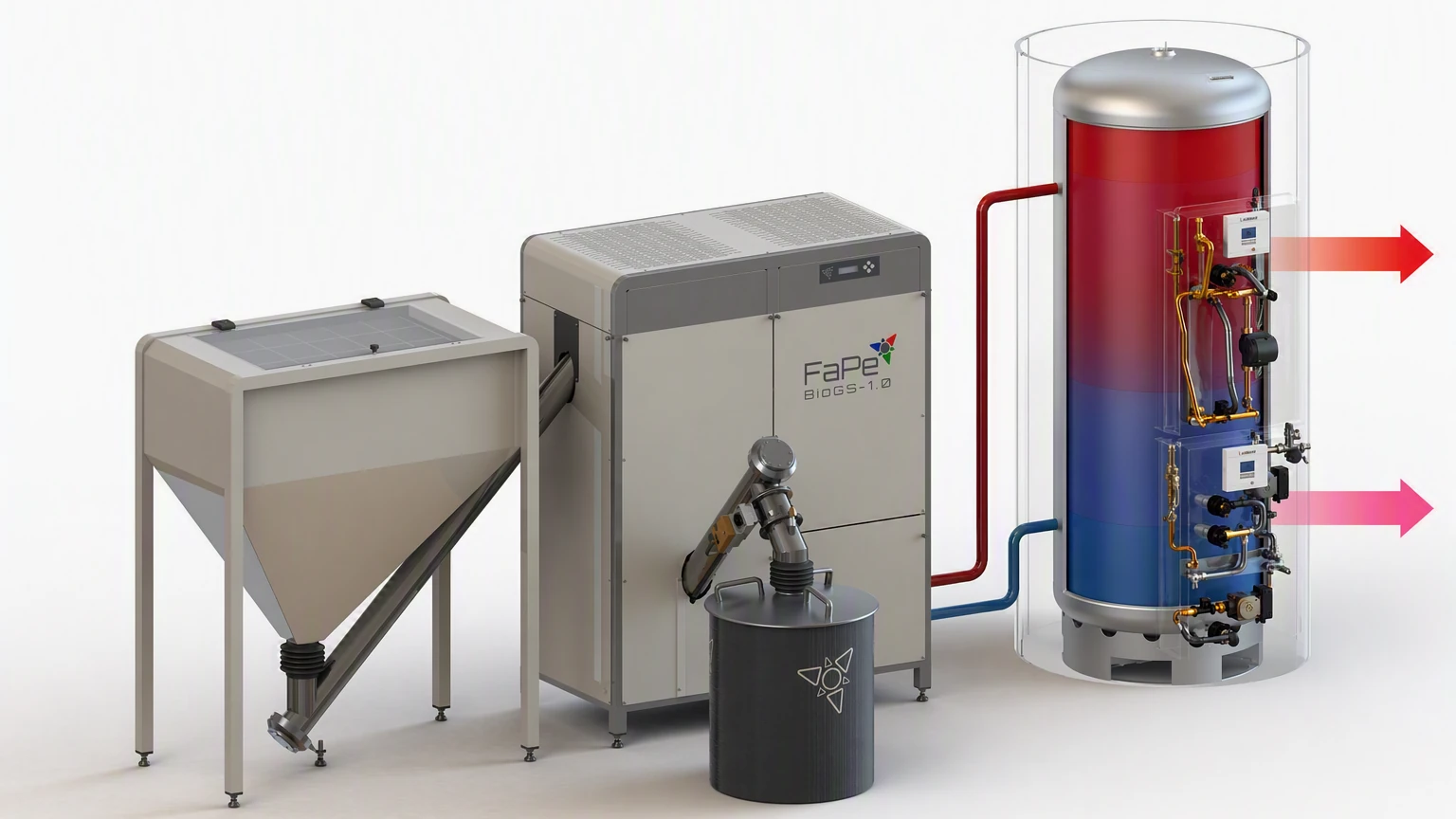
What the puffer tank is
The puffer tank, in technical terms a "thermal accumulator" or "thermal storage tank," is an insulated vessel filled with water whose job is to temporarily store the thermal energy produced by a heat source and release it according to the building's actual needs. The water it contains is called "technical water," meaning it is not directly usable from taps because it is normally treated with anti-corrosion film-forming additives.
The puffer tank operates on a closed loop: for heating, the water contained inside it can be used directly, but for domestic hot water, heat is drawn off through heat exchangers that can be internal to the tank itself (coils) or external (plate exchangers).
In the BioGS-1.0 installation, the puffer tank is the thermal flywheel between the micro-cogeneration unit and the building's heating system or domestic hot water production, whose demand varies throughout the day.
The principle is simple: the water in the puffer tank heats up thanks to the heat coming from the energy system (micro-cogenerator or boilers), and this stored thermal energy is then available whenever it is needed, even when the micro-cogeneration unit (or the boiler) is not running.
The puffer tank therefore acts as a thermal battery: the energy is not lost, but simply stored while waiting to be used.
Why the puffer tank is indispensable in micro-cogeneration
Micro-cogeneration systems, such as BioGS-1.0, achieve maximum efficiency and service life when they operate as steadily as possible, ideally at a constant operating point for extended periods. A building's heat demand, however, is variable: it changes according to the time of day, weather conditions, occupancy of the spaces, and hot water consumption. Without a thermal accumulator, the unit would have to continuously vary its output or switch on and off repeatedly, which reduces combustion efficiency and shortens the service life of critical components.
The puffer tank resolves this contradiction by separating heat production from heat consumption. The micro-cogeneration unit can operate steadily at its optimal working point, while the puffer tank absorbs the dips and peaks in demand. The result is greater overall system efficiency, fewer start-stop cycles of the generator, and smoother, quieter operation.
A second important benefit is the so-called "intelligent oversizing of the generator": a sufficient reserve of hot water in the puffer tank allows the system to cover short consumption peaks without having to increase the unit's rated thermal output, thereby avoiding higher investment costs and a low annual utilization factor of the plant.
Thermal stratification and charge-discharge cycles
Inside the puffer tank, the phenomenon of thermal stratification takes place: hotter water has lower density and therefore rises toward the top of the tank, while colder, denser water sinks toward the bottom. This forms a vertical temperature gradient: the hottest layer is found at the top (from where water is drawn for the heating circuit and for domestic hot water) and the coldest layer is found at the bottom (from where water is drawn by the micro-cogenerator to be heated again).
Correct stratification considerably increases the usable capacity of the tank, because it allows high-temperature water to be drawn even when the total volume of the tank is not yet fully charged. Conversely, unwanted mixing of the layers, which can occur due to inadequate hydraulic connections or excessive flow velocities at the inlets, compromises stratification and significantly reduces the efficiency of the storage.
The charge and discharge cycle of the puffer tank repeats several times over the course of the day: during periods of low consumption the puffer tank recharges with the heat produced by the micro-cogeneration unit, while during peak demand periods (for example, morning and evening) the stored energy is drawn off faster than the unit can produce it.
Sizing and capacity: how many liters are needed
The volume of the accumulator is chosen based on the thermal output of the micro-cogeneration unit, the building's expected consumption profile, and the desired autonomy time. As a general guideline, in applications of micro-cogenerators such as BioGS-1.0, the recommended volume is usually in the order of hundreds of liters per kilowatt of installed thermal output, but the specific value must always be sized case by case at the design stage, taking into account the type of building, the insulation, the number of occupants, and the possible presence of other heat sources.
An undersized puffer tank cannot cover consumption peaks and forces the micro-cogeneration unit into frequent start-stop cycles, negating the benefits of the storage. An oversized puffer tank lengthens the time needed to reach operating temperature and increases heat losses from the tank surface, although these losses are minimal in modern, well-insulated accumulators.
- Single-family homes: the typical puffer tank volume is 800/1000 liters.
- Farms and small commercial buildings: capacity is calibrated based on the simultaneous thermal needs for heating and production processes.
- Buildings with highly variable consumption (e.g. agritourism facilities, hospitality venues): greater capacity ensures superior thermal comfort during peaks.
Integration into the BioGS-1.0 system
In the BioGS-1.0 installation, the puffer tank is hydraulically connected to the micro-cogeneration unit with two lines (flow and return), the circulation pump is already fitted on board the machine, and the control electronics continuously monitor and modulate temperature and flow rate.
A temperature probe is, in addition, positioned at an intermediate height of the accumulator.
The maximum temperature obtainable at the top of the puffer tank with BioGS is approximately 65°C; under this condition, the lowest point will be at a temperature of 55°C.
Thanks to the puffer tank it is possible to fully exploit the capabilities of the BioGS system in terms of:- maximization of electrical output, drawing water from the lower-temperature zone makes it possible to optimize the micro-cogenerator's electrical efficiency thanks to a greater temperature difference across the Stirling engine;
- integration with other heat generators, multiple sources can feed heat into the same accumulator, and BioGS is able to manage them by giving priority to the most advantageous ones;
- balancing of thermal output, in the event of a surplus of electrical energy and a shortfall of heat, BioGS can automatically switch on an electric heating element inside the puffer tank to increase hot water production.
The puffer tank as a lever for overall efficiency
Although the thermal accumulator does not produce energy directly, its presence directly influences the overall efficiency, reliability, and cost-effectiveness of the BioGS-1.0 installation. It allows the micro-cogeneration unit to operate in a stable, efficient regime, reduces start-up cycles, extends the life of critical components, and improves user comfort by ensuring heat availability even at times of peak consumption.
From this perspective, the puffer tank is not an accessory element of the plant, but an integral part of the design that determines whether the system fully exploits the potential of biomass micro-cogeneration. Correct sizing and hydraulic connection of the tank should always be part of a professional installation design, not treated as a secondary detail.